
Review of a Collection of Naum Faiq’s Poems
by
Abdulmesih BarAbraham
A new book under title „The Poetry of The Assyrian Awakening: THE POEMS OF NAUM FAIQ“ appeared recently by the publishing house Lulu.com. The book is edited by Yosef Bahdi, who transcribed and translated all poems into English originally written and/or published by Naum Faiq.
At first glance two reasons make this book particularly unique: First, and as Prof. Shabo Talay notes in the foreword to the book, this is the first time that Faiq’s multilingual collection of poems and songs has been compiled into a single volume. A second aspect is that the translation of the poetry into English has made the collection accessible to a wider readership, as until now, and regardless of physical accessibility [1], a knowledge of classical Syriac, Arabic, and Ottoman Turkish was required to fully understand Faiq’s texts. Bahdi succeeded in producing a precise transcription of the Garshuni texts (using Syriac alphabet) from Arabic and Ottoman Turkish, as well as – along with the original Syriac texts – their translation into English.
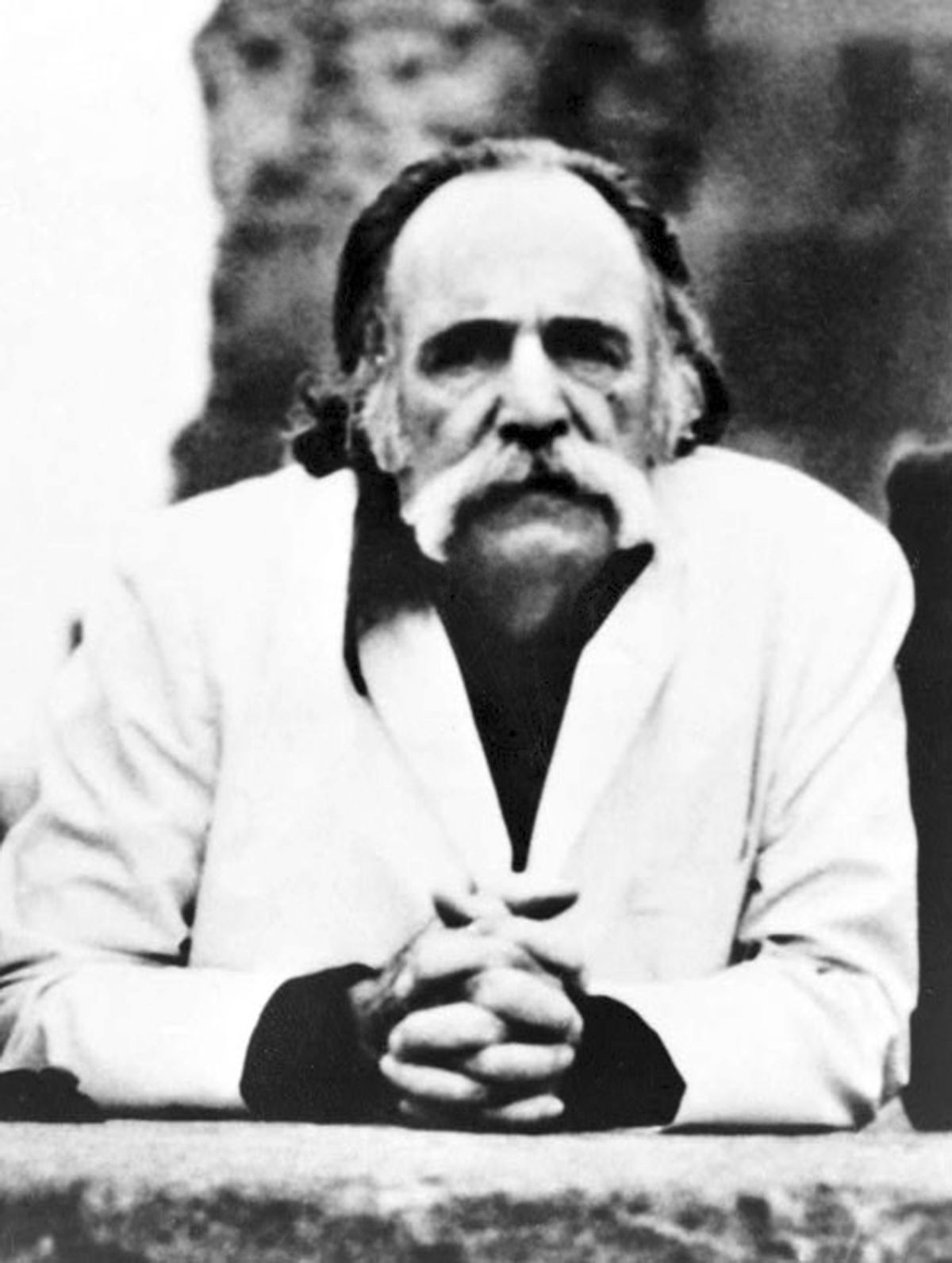
Naum Faiq (1868–1930) is regarded as one of the most prominent pioneers of modern Assyrian national enlightenment and revival movement: Born in Diyarbekir, he received a comprehensive multilingual education and dedicated his life to teaching and the cultural renewal of his people. His multi-lingualism laid the foundation for his later dictionaries, language collections, and journalistic works.
From 1910 to 1912, Faiq published the journal Kawkab Madinho (Eastern Star). He was a key figure in the Awakening Movement (Intihab Society – Knushto d-Ciruṯo), which he co-founded in Diyarbakır in 1908 and which grew to fifteen branches in Upper Mesopotamia by 1914. In the United States, the first branch of the Intibah Society was established in 1909 by his friend Gabriel (Jabbur) Boyajy, who also launched the magazine of the same name that same year.
Following increasing persecution in the Ottoman Empire, Faiq fellt compelled to emigrate to the United States in 1912, where he continued his journalistic work and became a defining voice of the diaspora through newspapers such as Bethnahrin (Mesopotamia) and Huyodo (Union). His writings emphasized education, linguistic unity, and interdenominational solidarity among the Assyrians.
Until his death in 1930, Naum Faiq remained a moral and intellectual leader whose work is still regarded today as the cornerstone of the Assyrian unity movement. He is considered one of the first to have promoted a non-denominational Assyrian identity – transcending ecclesiastical divisions among the members oft he Syriac-speaking Churches (Jacobite Orthodox, Chaldean Catholic, Nestorian). His writings called for education, unity, cultural renewal, and political awareness. His legacy is honored in Assyrian communities worldwide, including through annual commemorations on February 5.
The collection of poems published by Bahdi is accompanied by a carefully crafted scholarly apparatus that gently introduces readers to the life, work, and historical context of Naum Faiq. Following the foreword and an introduction by the author, which outline the thematic framework, there are sections on methodology and challenges that explain the editorial approach. Bahdi aimed for a careful, primarily literal translation in order to preserve Faiq’s original meaning, word choice, and style as accurately as possible. Considering that the translation of poetry is generally challenging, the problem in this case was compounded by the different languages and their historical and cultural contexts. According to Bahdi, the transcription of handwritten Garshuni texts into Latin/standard script was in some cases more difficult than the actual translation.
Bahdi considered it particularly important to devote detailed attention to the terminology used to refer to the Assyrian people in English, which sheds light on the linguistic and political context of the edition. An additional historical focus is the highlighting of the Assyrian Genocide (Sayfo 1915) in Naum Faiq’s poetry; even though he had lived in the United States since 1912, he wrote and published several poems—which Bahdi points to – in which Faiq described the atrocities committed against his people and appealed for help for his people back home.
This context is supplemented by a description of the source material, including a systematic list of all published poems.
This volume offers the most comprehensive English translation to date of Naum Faiq’s poetic works and includes all surviving poems, hymns, and patriotic songs that he published between 1909 and 1929, both in his two poetry collections from 1913 and 1917, and in the numerous newspapers he founded or edited. In addition to Faiq’s own texts, the edition also includes poems by his patriotic comrades in the revival movement, which originally appeared in his publications as well. A total of 130 poems have been compiled and translated in this volume, 86 of them by Faiq himself and 44 by other authors. The broad collection and the range of topics addressed make it clear how closely Faiq’s poetic work was linked to his journalistic endeavors and his commitment to the cultural and national renewal of the Assyrian people.
An afterword and a bibliography conclude the volume, rounding out the edition editorially and providing further guidance.
Concluding remarks
According to Prof. Talay, by providing the transcription and translation of all Faiq’s poems along with their facsimiles, Yosef Bahdi accomplished “a pioneering achievement that makes the original texts accessible for research and study.” There is not much to add to this assessment.
To conclude this brief review, it seems appropriate to share a poem from the collection as an example, to illustrate how Faiq used poetry as a means of collective encouragement. My choice is the second part of a poem titled “The Assyro-Chaldean Delegation,” which Faiq dedicated to the delegations sent from the United States to lobby for the Assyrian question at the Paris Peace Conference. The poem (pp. 273), consisting of 10 stanzas, appeared in Faiq’s Bethnahrin magazine in April 1919. According to Faiq, the delegates’ mission was “to address the various injustices inflicted upon our Assyrians, who are oppressed by the Turkish barbarians, and to protect our people from future attacks by other nations.”
The first five stanzas (1-5) in form of a patriotic hymn, praise the Assyrian delegates at the Paris Peace Conference; in a solemn tone, Faiq elevates the delegates to bearers of national hopes and divine providence, linking their political mission to a moral calling.
The second part (stanzas 6-10, see below) of the poem unfolds as a powerful wake-up call to the Assyrian people, combining political passion with moral exhortation. In forceful imperatives, Faiq calls for unity, self-liberation, and national awakening. Particularly striking is the linking of historical suffering – the blood of the martyrs – with a vision of a shared future that seems possible only through solidarity. Thus, the poem exemplifies Faiq’s poetic program, which inextricably links national identity, moral renewal, and political vigilance.
The poem serves as an example of how Naum Faiq uses poetry as a means of collective encouragement – not so much as an expression of personal emotion, but rather as a rhetorical tool to strengthen a traumatized people in search of international recognition and self-determination.
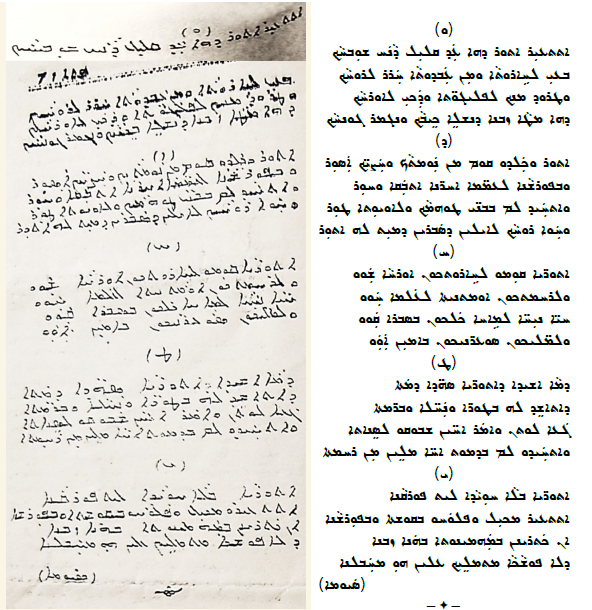
. [Part 2 of the Poem 106, pp. 273 – Faximilie and transcription]
English Translation:
(6)
Awake, Assur, for your glory will soon dawn!
Demand freedom and liberate yourself from slavery
Shake off divisions and purify your path,
The time has come; your weeping will cease, and your disaster will end
(7)
Assur-Chaldo, rise from your slumber and prepare yourself,
Behold and observe the other peoples with discernment
Unite with the offspring of your lineage in harmony,
And show yourself to those who think Assur is dead
(8)
O Assyrians, arise and pave the way to freedom!
Show your love for your nation to the world
Remain hopeful of living a life of serenity,
Always aligning your words with your deeds
(9)
The blood of Assyrian martyrs, spilled for the nation,
Shed in mountains, valleys, and hills,
Cries out to us: “O brothers, cast off hatred,
And unite as brothers filled with love”
(10)
O Assyrians, without unity, there is no salvation
Awaken now and work with justice and discernment
If we persist in neglect during this time,
Destruction will surely overwhelm us.
—
[1] It was only with the establishment of the Modern Assyrian Research Archive (MARA) in 2008, which managed locating, collecting, and digitizing early periodicals like Kawkab Madenho, Bethnahrin and Hujodo, that the full scope of Naum Faiq‘s literary output finally came to light.